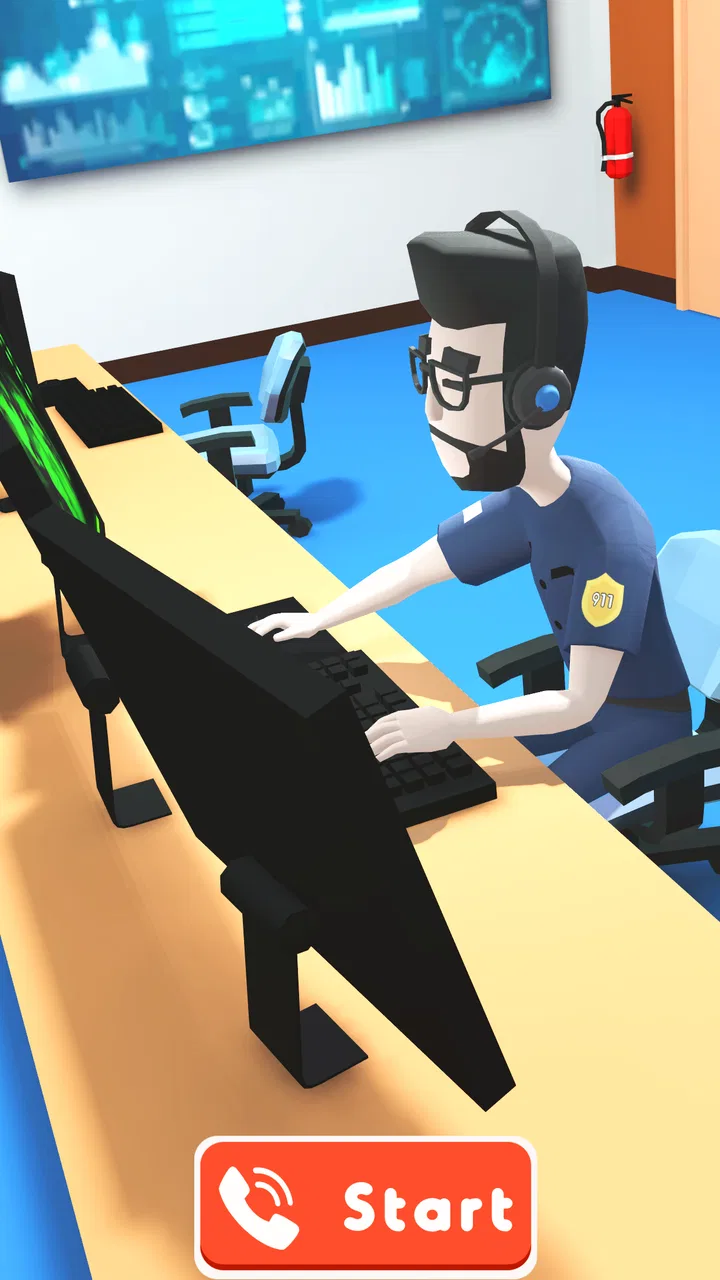
911 Emergency Dispatcher
- 4.6
- Rating
- 10.00M
- Installs
- Free
- Price

 Analysis by App-foxy
911 Emergency Dispatcher turns the familiar idea of answering emergency calls into a role-playing game about making quick decisions under pressure. I found its strongest quality in the way it makes a simple prompt feel important: someone needs help, and I have to decide what should happen next. That central capability gives the game a clear identity instead of making it feel like another role-playing title built around battles, equipment, or character statistics.
Developed by Supersonic Studios LTD, the game is free to download and aimed at players aged 10 and over. Its store summary is “Send the HELP needed NOW!”, but that short line does not really explain the appeal. The interesting part is not merely responding to an emergency. It is the tension created by having to interpret a situation, choose a response, and live with the feeling that a careless decision may send the wrong kind of assistance.
I would describe it as a decision-focused emergency role-playing game. It is easy to begin, works well in short sessions, and has a much lighter learning curve than a traditional role-playing game. At the same time, it is not a realistic dispatcher simulator. The experience is designed for quick entertainment, so anyone expecting detailed radio procedure, authentic emergency-service training, or a deep management system should adjust their expectations before installing it.
You May Also Like

 Blood Strike: 2.5 Anniversary
Blood Strike’s Loadouts Turn Every Drop Into a Tactical Gamble
A close look at Blood Strike’s custom loadouts: how fast access to signature weapons reshapes its battle royale rhythm, rewards preparation, and narrows the gap between fights.

 Pandora - Music & Podcasts
Pandora’s Music Is Easy to Start, but Harder to Recover
Pandora’s strength is its low-effort path from a seed to a station. Its weak spot is how much confidence it asks you to place in connection, setup, and quiet recovery.

 8 Ball Pool
 Is Built on Rivalries, Rematches, and Routine
A close look at the rivalries, rematches, shared routines, and unanswered safety questions that turn a quick pool match into a persistent mobile community.

 Samsung Music
’s Quiet Strength Is Playing What You Already Own
Its reach comes less from spectacle than from dependable access to a personal library. That simplicity is both the app’s strongest retention engine and its ceiling.

 AccuWeather: Weather Radar
AccuWeather Review: A Quick, Clear Forecast for Everyday Decisions
For everyday plans, the best forecast is the one you can understand quickly. AccuWeather makes rain timing, radar, and local conditions easy to act on, with a few trade-offs.

 Hill Climb Racing
Why Hill Climb Racing Still Turns Crashes Into One More Run
A tiny car, a bumpy hill and one more upgrade: Hill Climb Racing keeps resurfacing because its simple chaos makes every near-miss feel personal.
More From Our News Desk
View All News


Why the emergency-response capability matters
The main capability is the chance to act as the person who receives a call for help and determines the next response. That sounds straightforward, but it changes the player’s role in a useful way. I am not controlling a hero who arrives after the problem has already been identified. I am working at the first point of contact, where the information may be incomplete and the decision has to be made before I know the full outcome.
That perspective creates a different kind of pressure from the usual role-playing formula. In many mobile games, the most important choice is which attack to use or which upgrade to buy. Here, the satisfying moment comes from matching the situation with an appropriate response. The game’s basic loop is therefore built around judgment rather than reflexes. I pay attention, select an action, and see whether my choice moves the situation in the right direction.
This is also why the game can appeal to people who do not normally spend much time with role-playing games. There is no need to learn a large fictional world before the central idea makes sense. The premise is immediately understandable: a caller needs help, and I am responsible for sending the appropriate assistance. That clarity makes it suitable for a quick break, especially when I want something interactive but do not want to memorize a complicated control scheme.
The role-playing label is important, though. The game is not simply a collection of unrelated emergency scenarios. My decisions are framed as part of a continuing role, so the feeling of progress comes from becoming more confident in the dispatcher position. I enjoyed that sense of responsibility more than I expected, particularly when a situation initially looked simple but required me to slow down and consider the details.
The best way to play is to treat every call as an information problem, not a speed test. That small change in attitude makes the experience more rewarding. Instead of tapping the first obvious option, I try to understand what the caller appears to need and what kind of response would logically follow. Even when the game keeps the interaction accessible, this habit gives each decision more weight.
How it feels during an ordinary session
In practice, the game is built for short interactions. I can open it, handle a few situations, and put it down without needing to reserve a long uninterrupted period. That makes it a natural fit for a commute, a waiting room, or the few minutes before bed. The compact structure also prevents the emergency theme from becoming exhausting too quickly.
The first thing I noticed is how much the game depends on reading the situation carefully. The wording of a call matters because the response should follow the circumstances rather than my personal preference. I found it useful to pause before selecting anything, even when the answer seemed obvious. That pause is not wasted time; it is the part of the game where the role-playing element actually happens.
A practical routine helped me play more consistently. I would first identify the immediate danger, then separate that from secondary details, and finally choose the response that addressed the urgent problem. This is not a complicated strategy guide, but it prevents the common mistake of reacting to the most dramatic detail instead of the most important one. Players who rush through the text may finish a session quickly, yet they can miss much of the decision-making that gives the game its character.
The game is also approachable for younger players within its age rating because the premise is easy to understand. Still, I would play alongside a child at first rather than assuming the emergency theme will suit everyone. Some players may find the subject matter uncomfortable, while others will enjoy the responsibility and the chance to think through different situations. The right reaction depends more on personal sensitivity than on the controls.
One useful way to enjoy it is to use it as a conversation game. If I am playing near a friend or family member, I can explain why I would choose one response over another before confirming it. That turns a solitary mobile game into a small exercise in reasoning. It is especially effective with someone who likes puzzles but does not want a traditional puzzle board or a timed arcade challenge.
A realistic everyday use case
Imagine having a short break after lunch. I do not have enough time for a long role-playing adventure, but I want something more engaging than scrolling through social media. I open 911 Emergency Dispatcher and handle a few calls. Rather than needing to remember a complex quest, I can focus on the immediate situation in front of me. If I make a poor choice, the result feels connected to my decision instead of being caused by an unfamiliar control system.
That scenario shows where the game works best. It provides a compact mental reset while still asking me to pay attention. The emergency setting gives the session a sense of purpose, and the dispatcher role makes the activity feel different from simply matching tiles or collecting rewards. I would not call it relaxing in the same way as a quiet puzzle game, but it can be satisfying when I want a small challenge with a clear beginning and end.
It is also a reasonable choice for players who enjoy “what would you do?” situations. The game encourages me to compare the available responses and think about consequences. I found that more appealing when I played deliberately, because the experience became less about tapping through a sequence and more about testing my judgment. That is a subtle strength that a short store description cannot communicate.
On the other hand, this is not the best companion for someone who wants a deep story during a long session. The individual decisions are the focus, so players looking for extensive character relationships, exploration, or a large fantasy world may quickly feel that the format is too narrow. A conventional role-playing game would offer more variety in combat, customization, and world-building.
The tradeoffs behind the simple design
The accessible format is both the game’s advantage and its main limitation. Because the central interaction is easy to understand, I could start playing without studying instructions. However, players who want a broad set of systems may find the experience repetitive sooner than they would with a more traditional role-playing title. The game’s identity depends heavily on whether making emergency decisions is interesting enough to sustain attention over time.
Another tradeoff is the difference between dramatic subject matter and casual mobile presentation. Emergency calls naturally suggest serious consequences, but the game packages them as a streamlined entertainment experience. I appreciated that it did not require professional knowledge, yet I would not use it as a substitute for real emergency training. Its value is in creating a decision-making scenario, not in teaching people how to handle actual emergencies.
The free price makes it easy to try, but the game includes in-app purchases priced from $2.99 to $4.99 per item. I recommend beginning without spending anything and deciding whether the core loop holds my attention first. That is particularly important here because the game’s appeal comes from its repeated decisions; paying for extras will not change whether I enjoy that central activity. A free starting point lowers the risk, while the optional purchases are worth considering only after I understand my own play habits.
There is also a difference between playing for quick amusement and playing for mastery. If I simply want to tap through calls, the game can feel lightweight. If I slow down, compare the clues, and treat each response as a judgment call, it becomes more involving. In other words, part of the depth is created by the player’s approach. That is a strength for thoughtful players, but it may disappoint anyone expecting a highly complex system to provide the challenge automatically.
The game is currently listed as version 1.084 and supports devices running Android 7.0 or later. That makes checking device compatibility worthwhile before downloading, especially if I am using an older phone or tablet. The practical benefit is that the game is not positioned as a demanding, long-form experience, but compatibility still matters when deciding whether it will run comfortably on a particular device.
How it compares with familiar alternatives
Compared with a standard mobile role-playing game, this one replaces combat and character builds with situational judgment. I do not come here for elaborate equipment choices or a large party of heroes. I come for the feeling of being responsible for the first response. That makes it a better fit for players who enjoy reading, choosing, and anticipating consequences than for players who want action-heavy progression.
Compared with a puzzle game, it has a stronger narrative frame. A puzzle usually asks me to find the correct arrangement or solution, while this game places the decision inside an emergency context. That context makes the choice feel more urgent, even when the underlying interaction remains simple. If I want a calm logic exercise, another puzzle game may be preferable. If I want my decisions to feel connected to a situation, this title has the advantage.
Compared with a serious simulation, it is much easier to enter but far less suitable for training or realism. I do not need specialist knowledge to understand the premise, and I can play casually. The tradeoff is that the game should be judged as a role-playing experience rather than as an accurate representation of dispatch work. That distinction matters because the emergency theme may otherwise create expectations the game is not designed to fulfill.
Its store performance suggests broad interest: it has an average rating of 4.6 from around 260 thousand ratings, with more than 10 million installs. I see those figures as evidence that the basic idea connects with many mobile players, not as a guarantee that every player will enjoy the format. The repeated-call structure remains the deciding factor. If that sounds appealing, the game is easy to recommend as a free trial; if it sounds monotonous, popularity will not solve the mismatch.
Who will get the most from it
I would recommend 911 Emergency Dispatcher to players who enjoy making choices with limited information, short role-playing sessions, and scenarios that can be understood immediately. It is especially suitable for someone who wants a game that feels purposeful without demanding a large time commitment. Players who like discussing possible outcomes with friends or younger family members may also find more value in it than someone who always plays alone and rushes through dialogue.
It is less suitable for anyone seeking a detailed emergency-services simulator, a story-rich adventure, or a combat-centered role-playing game. I would also suggest skipping it if the emergency theme itself is likely to cause discomfort. The game’s appeal depends on engaging with the responsibility of the role, and that premise will not be enjoyable for everyone simply because the controls are accessible.
For new players, my advice is simple: do not judge it by the first few taps alone. Read each situation, identify the urgent need, and consider why one response fits better than another. Avoid spending money until the decision loop feels satisfying on its own. If the game still feels engaging after several short sessions, the free format gives it a useful place in a mobile library.
Overall, I found 911 Emergency Dispatcher most successful when it stayed focused on the act of deciding what help should be sent. That single capability gives the game its personality and separates it from more familiar role-playing alternatives. It is not a deep simulator, and it does not try to be one. Instead, it offers a compact, accessible way to test judgment in urgent situations. For me, that makes it worth trying, provided I approach it as a decision-driven mobile game rather than a realistic lesson in emergency dispatch.
Supersonic Studios LTD has built the experience around a clear hook, and the free entry point makes exploring that hook straightforward. The age rating of Everyone 10+ also gives families a useful starting reference, though individual comfort with emergency themes still matters. My final recommendation is favorable for casual players who want meaningful choices in short sessions, while fans of expansive role-playing systems should look elsewhere for greater depth and variety.
FAQs for 911 Emergency Dispatcher
01What is 911 Emergency Dispatcher and what can I do in the game?
911 Emergency Dispatcher is a simulation game where you take on the role of an emergency call operator. Your main task is to handle incoming emergency calls, assess the situation, and dispatch the appropriate emergency services. The game challenges your decision-making skills as you prioritize calls and manage resources efficiently.
02Is 911 Emergency Dispatcher available for both Android and iOS devices?
Yes, 911 Emergency Dispatcher is available for download on both Android and iOS platforms. You can find it on the Google Play Store for Android devices and the Apple App Store for iOS devices. Be sure to check the system requirements to ensure compatibility with your device.
03Does 911 Emergency Dispatcher require an internet connection to play?
911 Emergency Dispatcher can be played offline, allowing you to enjoy the game without a constant internet connection. However, certain features, such as updates or in-app purchases, may require internet access. Playing online might also enable leaderboards and other community features.
04Are there any in-app purchases in 911 Emergency Dispatcher?
Yes, 911 Emergency Dispatcher includes in-app purchases. These can range from additional game content to boosters or upgrades that enhance gameplay. While the game is free to download, these optional purchases can enhance your experience and help you progress faster.
05What age group is suitable for playing 911 Emergency Dispatcher?
The game is generally suitable for players aged 12 and up, due to its emergency scenarios and decision-making aspects. Parents may want to review the content to ensure it aligns with their expectations, as the game involves handling realistic emergency situations and requires mature judgment.
Pros
- Intuitive user interface design.
- Engaging gameplay mechanics.
- Realistic emergency scenarios.
- Variety of levels and challenges.
- Educational value in crisis management.
Cons
- Repetitive tasks can become tedious.
- Limited customization options.
- In-app purchases can be pricey.
- Requires constant internet connection.
- Occasional slow loading times.

911 Emergency Dispatcher
Gallery